







Regional Integration Drives Venezuela-Colombia Agenda
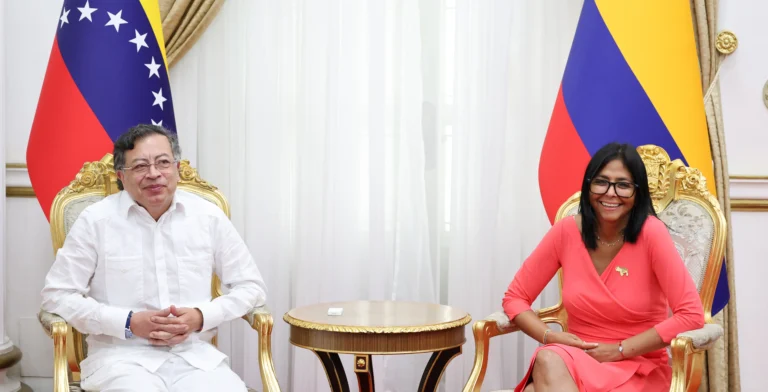
The meeting between the Colombian president and the Venezuelan Acting President marks the first official visit of a Head of state to Caracas after the kidnapping of the constitutional President Nicolás Maduro. Photo: Venezuelan Presidential Press.
April 24, 2026 Hour: 9:38 pm
🔗 Comparte este artículo
The Governments of Venezuela and Colombia agreed today on significant steps to advance their binational agenda, following their meeting at Miraflores Palace in Caracas.
Venezuelan Acting President Delcy Rodríguez and Colombian President Gustavo Petro announced on April 24 bilateral agreements, which include plans for electricity and gas interconnection, boosting tourism and combating criminal gangs and transnational crime on the shared border.
RELATED: Venezuela-Colombia Third Commission Meeting Boosts Regional Integration
Rodríguez highlighted the arrival of Gustavo Petro to the Colombian Government in 2022 as a pivotal moment that enabled the reopening of the border after seven years of diplomatic rupture. This re-establishment of ties led to a significant increase in bilateral trade, which, after declining to minimal levels, soared to 1.5 billion dollars last year, despite the economic blockade imposed against Venezuela.
Both Governments are now prioritizing an import substitution policy to further strengthen the consumption of locally produced goods, aiming for greater economic sovereignty and resilience against external pressures.
In this sense, President Gustavo Petro strongly advocated for the reconstitution of economic, social, and political unity and integration between the two countries.
President Petro championed the Bolivarian project as a viable model for a confederation in the 21st century, asserting that such an alliance would empower the region to become one of the most robust and powerful globally. Following this, he envisioned this union from a diverse and pluralistic perspective that deeply respects national autonomies, fostering a collective strength while honoring individual sovereignty.
Shared Border Plan
In the critical area of security, Petro proposed a concerted effort to liberate border communities from mafias deeply involved in illegal economies. He specifically cited the urgent need to combat cocaine trafficking, illicit gold mining, human trafficking and the illegal extraction of rare minerals. This comprehensive strategy envisages combined military, police and social actions designed to ensure that the border becomes an exclusive and secure space for the Colombian and Venezuelan peoples, free from the corrosive influence of organized crime and illicit activities.
“We have agreed on the elaboration of military plans and the immediate establishment of mechanisms for information sharing and intelligence development, which must come into effect immediately”, affirmed Venezuelan Acting President Delcy Rodríguez.
Deepening Cooperation Alliances
The meeting aimed to significantly strengthen cooperation alliances across commercial, energy, political, and security sectors, within the framework of the Colombia–Venezuela Presidential Meeting. In this sense, the binational agenda made energy and food integration a priority.
Following this, Delcy Rodríguez reported on the plans for electricity interconnection to western Venezuela, a sector affected by the disinvestment resulting from U.S. coercive measures against the country. The comprehensive agreement further includes the export of Venezuelan gas to Colombia and ambitious joint projects aimed at supplying third countries, thereby positioning both nations as key players in the regional energy landscape and fostering greater economic interdependence and shared prosperity.
Rodríguez also specified that it has been agreed to replace imports from the two countries by taking advantage of products that are generated on both sides of the border. “It makes no sense for Colombia or Venezuela to look to other latitudes for what we can achieve in our own territories”, declared the Venezuelan Acting President, emphasizing the immense potential of bilateral collaboration.
The day’s agenda was preceded by the III Meeting of the Binational Good Neighbor Commission, where eleven technical working groups were established. These groups focused on critical areas such as energy sovereignty, health, defense, and environmental affairs, reflecting the comprehensive nature of the planned cooperation.
This historic gathering also marks the first official visit of a Head of State to the Venezuelan capital since the U.S. kidnapping of constitutional President Nicolás Maduro last January 3, adding a layer of profound political significance to the discussions and underscoring Venezuela’s ongoing efforts to solidify regional alliances.
Author: Laura V. Mor
Source: Venezuelan Presidential Press